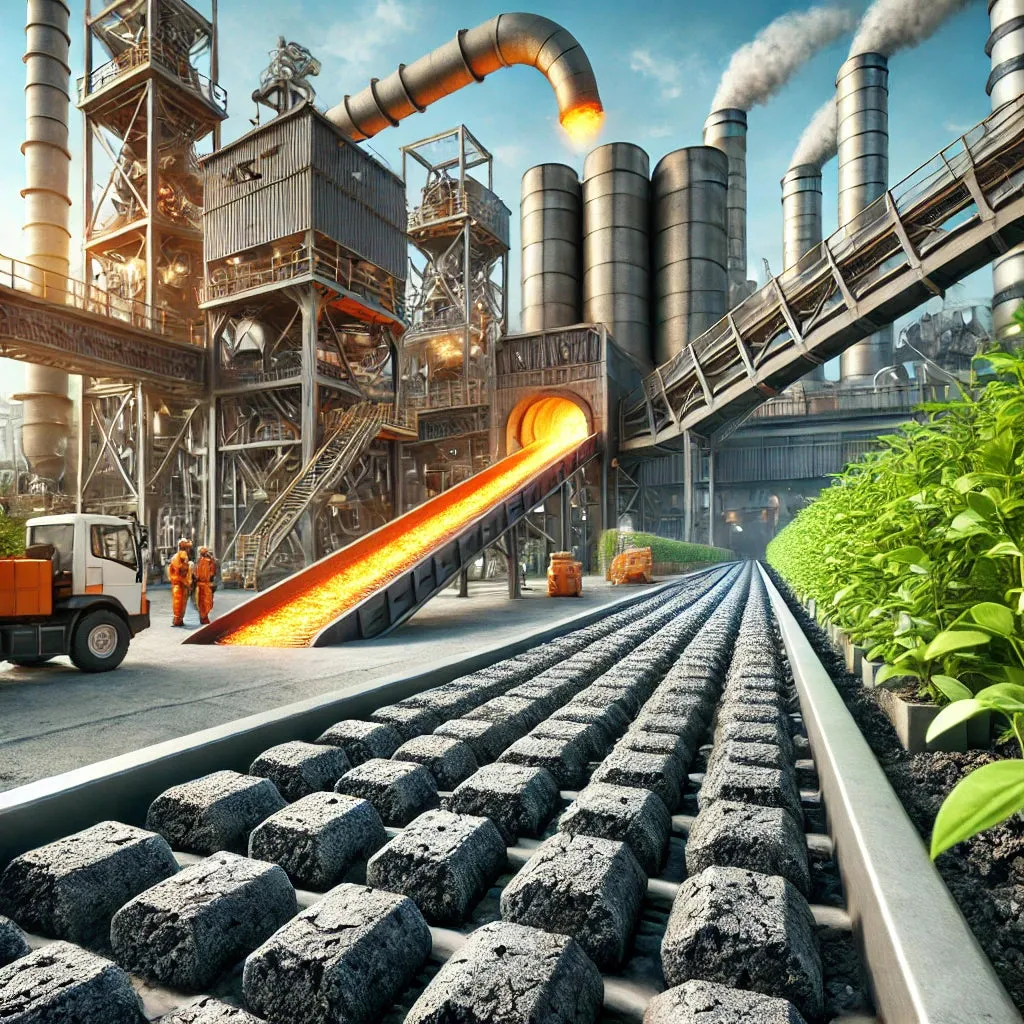
We examined the use of engineered biochar in the steel and cement industries. It will help reduce emissions, enhance efficiency, and lower production costs. We provided examples, experiments, and economic models to show how biochar can aid these sectors in becoming more sustainable and saving money.
The steel and cement industries are important for infrastructure but cause significant greenhouse gas emissions. These sectors need to cut emissions while remaining profitable and efficient. Engineered biochar, created from waste biomass through pyrolysis, is a possible carbon-negative solution that delivers both environmental and financial advantages.
Our main aims were to look at how premium engineered biochar can improve production in steel and cement, evaluate how emissions and energy use can be reduced, and explore the cost effects of its use on a larger scale.
Results
1. Steel Industry
Emission Cuts - Roughly 15% reduction in CO₂ emissions with 10% premium engineered biochar use.
Production Improvement - Better combustion efficiency and reduced impurities in slag.
Cost Review - Savings of $20 for every tonne of steel produced when including coke savings and carbon credits.
2. Cement Industry
Clinker Replacement - Cuts down 50 kg of CO₂ per tonne of cement.
Thermal Efficiency - Fuel savings range from $2 to $5 per tonne of cement.
Market Positioning - Cement with biochar is stronger, making it more valuable.
3. Economic Viability
Break-Even Evaluation - Steel industry observes a 2-year return on investment for biochar use.
Cement Industry - 1.5-year payback for using biochar and energy savings.
Lifecycle Savings - Estimated yearly savings of $500 million from lesser emissions, better operational efficiency, and longer equipment life in large plants.
Premium engineered biochar presents a big chance for the steel and cement industries to decrease carbon emissions and boost production efficiency while also reducing costs. Turning waste into useful resources aligns with circular economy principles and helps both the environment and the economy. Future initiatives should aim to increase biochar production, enhance its quality, and work with policymakers to support its use.
*For more details, please read our Research Paper published at https://www.ijmer.com/papers/Vol14_issue6/14067299.pdf*