
Metals
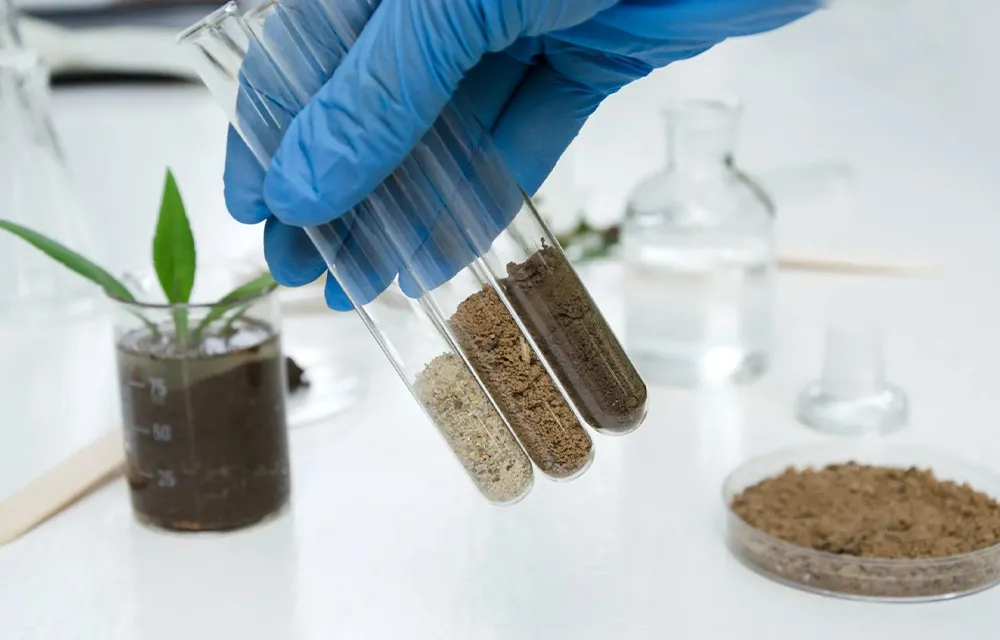
Biochar Now has commissioned comprehensive third-party tests for our product. Below is a table of some heavy metals, including some that are highly toxic. Due to its cation exchange ability, the results of removing the heavy metals are exceptional.
It is important to note that toxic substances are attracted to and bind to the walls of the biochar. They are locked in a molecular capsule and will not be released by themselves, so the roots of plants will not absorb the toxins held in the capsule.
| Metal | Symbol | Starting mg/L | % removed |
|---|---|---|---|
| Aluminum | Al | 638 | 100% |
| Arsenic | As | 203 | 100% |
| Barium | Ba | 0.17 | 66.0% |
| Beryllium | Be | 0.16 | 99.0% |
| Cadmium | Cd | 0.015 | 100% |
| Chromium | Cr | 166 | 100% |
| Cobalt | Co | 219 | 100% |
| Copper | Cu | 1.0 | 99.7% |
| Iron | Fe | 66 | 99.6% |
| Lead | Pb | 45 | 100% |
Nutrients
Nutrients are an important adsorption category for Biochar Now. Sometimes the data matter for the availability of nutrients (for example for plants) and sometimes for the removal of nutrients (for example cloudy water in fields and reservoirs).
In both cases the Biochar Now product performs well. Note that the porous biochar socks can be recovered once they are loaded with nutrients, and reused in gardens and agricultural fields to improve plant growth.
| Nutrient | Form | Starting mg/L | % absorbed |
|---|---|---|---|
| Phosphorus | non-soluble P | 27 | 99.9% |
| Phosphorus | P | 27 | 99.8% |
| Phosphate | PO4-P | 284 | 86.6% |
| Ammonia | N | 1.1 | 89.7% |
| Nitrate | NO3-N | 52 | 64.3% |
Solids
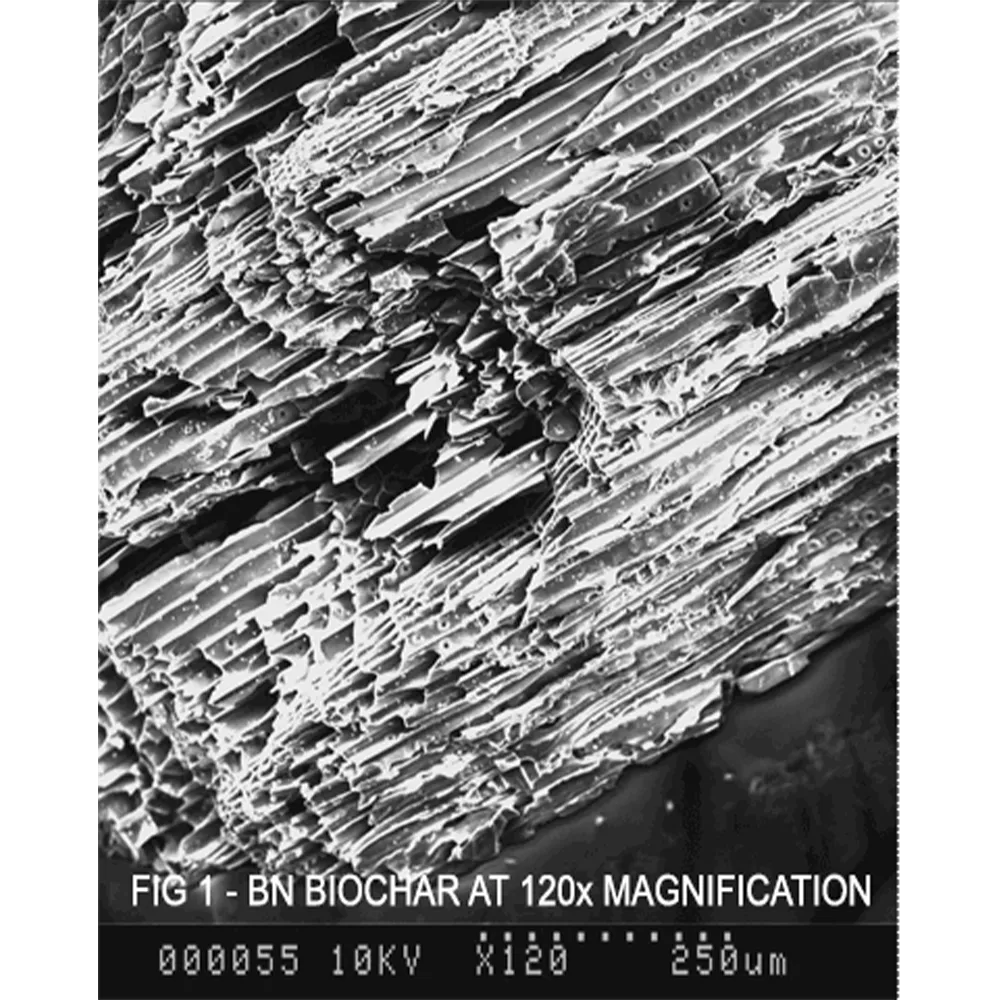
When biochar is loaded into a porous sock and laid in a lake, pond or polluted river, the natural currents carry the water through the biochar. Solids are physically filtered by the external structure of the biochar (see Figure 3). The physical removal of algae blooms (turbidity) and solids is very effective.
Toxic substances are attracted to and bind to the walls of the biochar. They are fixed in a capsule and are not released, so plant roots will not absorb the associated toxins.
Water adsorption
Water adsorption is a very important feature of biochar because of the drought conditions caused by climate change. Our biochar holds 5.6 times its weight in water, and the water is always available to the roots. Evaporation is negligible due to the long and narrow pores with very small openings at the edges, as can be seen in Figure 3 above.
- Water holding capacity
- 5.6×the weight of the biochar